 Gabriela Weinstein
Work / Project 01
Crumbl → Australia
Could one of America’s most viral cookie brands succeed in Sydney?
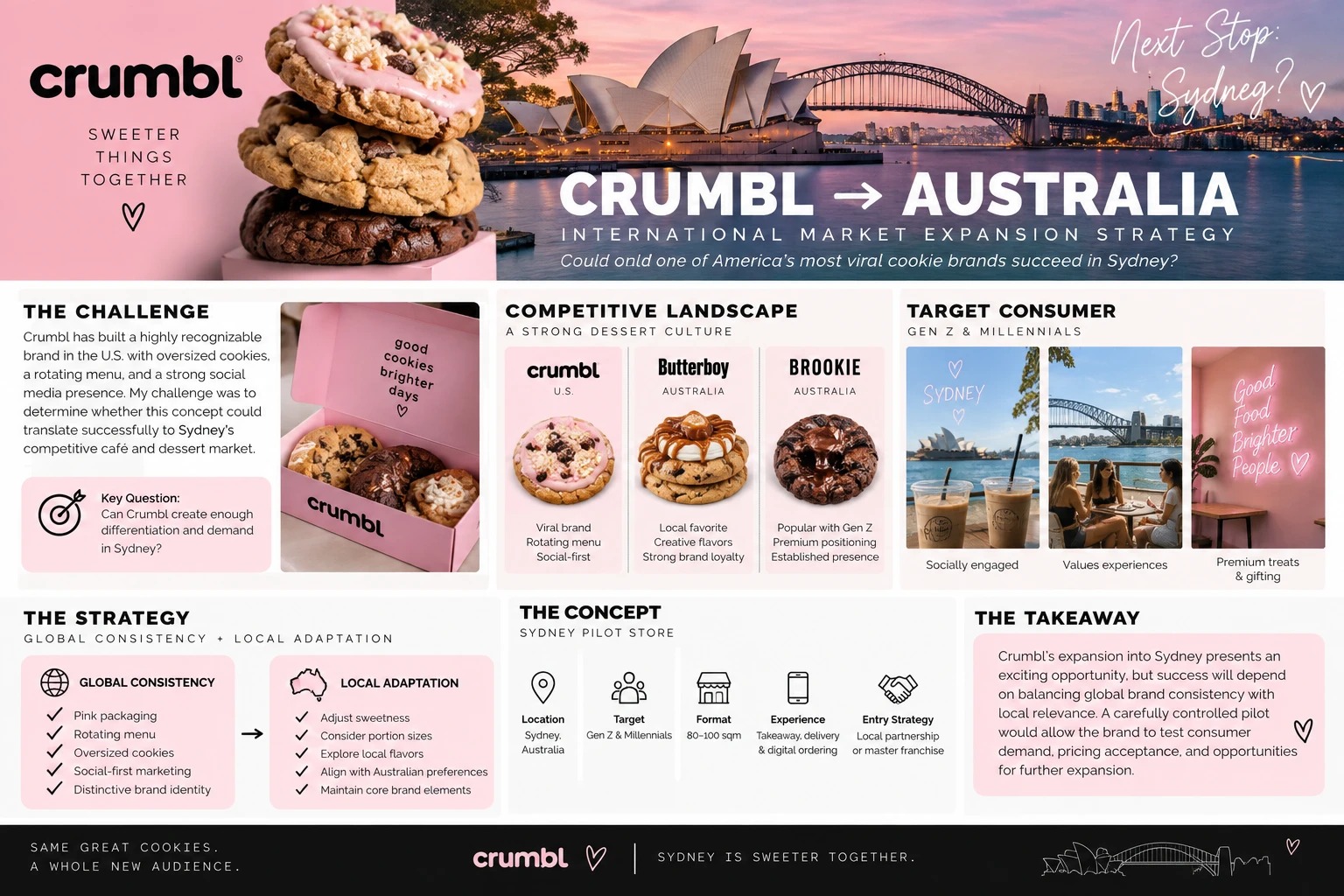
The strategy on one page — challenge, competitive landscape, target consumer, entry approach and recommendation.
The challenge
Sydney already has
a dessert culture.
Crumbl has built a highly recognizable brand in the U.S. on oversized cookies, a weekly rotating menu, and a social-first marketing engine. My challenge was to determine whether that concept could translate into Sydney’s competitive café and dessert market.
Sydney isn’t an empty category waiting for an American import. It has an established café culture, a mature dessert scene, and local players with genuine brand loyalty. The question wasn’t whether Crumbl could open a store — it was whether it could create enough differentiation and demand to be worth opening one.
Can Crumbl create enough differentiation and demand in a market that already knows exactly what it likes?
Competitive landscape
Who Crumbl would
be up against
Sydney’s dessert market is defended by brands that already own the qualities Crumbl leads with in the U.S. — creativity, indulgence, and a Gen Z following.
United States
Crumbl
- Viral, social-first brand
- Weekly rotating menu
- Oversized signature cookies
- Instantly recognizable pink identity
Australia
Butterboy
- Established local favorite
- Creative, inventive flavors
- Strong existing brand loyalty
Australia
Brookie
- Popular with Gen Z
- Premium positioning
- Established market presence
My approach
Four questions,
in order
I worked the way I’d want to work on a real entry brief: understand the market first, then the competition, then the person, and only then decide how to walk in.
Market research
Analyzed Sydney’s dessert culture, consumer behaviors, digital ordering habits, and broader market conditions to understand what demand actually looks like locally.
Competitive analysis
Evaluated local competitors including Butterboy and Brookie, and identified where Crumbl could genuinely differentiate rather than simply arrive.
Target consumer
Focused on Gen Z and Millennials — consumers who value premium treats, social experiences, gifting occasions, and visually engaging brands.
Entry strategy
Proposed a small-format Sydney pilot store supported by digital ordering, takeaway and delivery, entered through a local partnership or master franchise.
My recommendation
Keep what makes Crumbl, Crumbl.
The temptation with a new market is to soften everything that makes a brand distinctive. My recommendation was the opposite: protect the identity that earned Crumbl its following, and adapt only the things Australian consumers would actually notice on the palate.
Global consistency — hold these
- The pink packaging and visual identity
- The weekly rotating menu
- Oversized signature cookies
- Social-first marketing
- The distinctive brand experience
Local adaptation — flex these
- Adjust sweetness to Australian preferences
- Reconsider portion sizes
- Explore locally relevant flavors
- Align the menu with local tastes
- Keep every core brand element intact
The sequence
The concept
Sydney pilot store
Small enough to be a real test rather than a bet — designed so the brand could learn from the market before committing to it.
Location — the country’s most competitive dessert market, and the truest test
Target — socially engaged, experience-driven, premium treat & gifting buyers
Format — small footprint built for takeaway, delivery and digital ordering
Entry — local partner or master franchise to reduce risk and add market knowledge
The takeaway
Sydney presents an exciting opportunity for Crumbl — but success would depend on balancing global brand consistency with local relevance.
A carefully controlled pilot would let the brand test consumer demand, pricing acceptance, and appetite for further expansion before scaling. Writing this from inside the market changed how I think about international marketing: a brand doesn’t travel by being watered down, and it doesn’t travel by ignoring where it landed.